Showing posts with label ethnic food. Show all posts

Tuesday, October 30, 2012

In the Mood of the Season


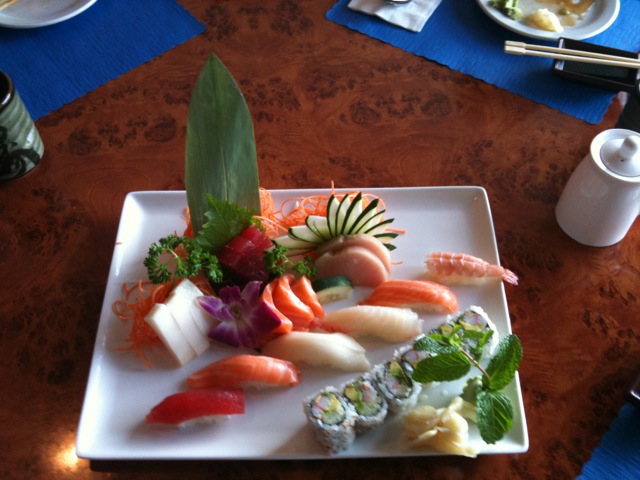
This picture was taken in the Yummy House – a small Asian place at 1725 Haggerty Rd, Commerce Township, MI 48390. It came as a little pleasant surprise to us and our friends.

The food tasted as good as it looks, if not better. The nicest thing about it was freshness of everything we tried and a really light feeling in our stomachs after the meal. Please notice that their pickled ginger (bottom right) is not dyed artificial red as it is done practically everywhere else. And of course, presentation! It seems that being recently open their owners make a real effort to offer good-quality Asian food for a moderate price. We just hope they stay this way in spite of all the challenges of the business. They are really small: 3 booths, one larger table and a bar.

And here is another picture taken recently by our friend Marina Holkin http://www.facebook.com/yacht.delma#. I think it is very much in the mood of the season.
Organic Apple Cider to celebrate the season
 
Enjoy!

Monday, October 1, 2012

Almost Raw Pumpkin

Currently we have 2 old friends all the way from Russia visiting with us. It just happened that they are also into vegetarian and organic food. So here is the pumpkin recipe that we half-checked on the Internet and half-improvised.

We bought 4 small pie pumpkins, because they are the cutest of them all. We cut them around the stem to make lids and scraped out all the seeds from inside to make 4 little edible pots. We actually scraped some more flesh from inside to make the walls thinner. Whatever pumpkin flesh we got, was cut in smaller pieces and started our stuffing.

I think that stuffing can be made of all sorts of things (vegetables, grain, even meat). Ours included cabbage thinly sliced (arpx. 1/4 of a small head), 1 sweet pepper, 3 celery stalks, 1 large yellow onion, a cup of frozen corn, 2-3 table spoons of olive oil, 4-5 generous drops of apple cider vinegar, allspice, salt, pepper and whatever other spice you like. Our choice was a Mediterranean mix that included cumin. Oh, and we put some fennel seeds as well.

We then stirred the stuffing with our bare hands (a habit that I quite forgot lately) and then stuffed our orange jolly pots by pressing the stuffing in as hard as we could. A little-bit of stuffing that was left we just ate as it was. This gives me the right to say that it can be eaten raw. It seems that all the range of cooking fits this recipe and depends entirely on your taste and convictions.

We baked our pumpkins with lids on at 450 F (just keep in mind that my stove is old and might not heat too well). It was ready in 45 min, or we just were too curious to let it stay in the oven for more.
This is the result

It tasted great - hot, though stuffing was still crunchy. I tried it with goat yogurt and chopped dill, my friends preferred sour cream instead. I think preparation time is about 30 min. If you like to make a use of the seeds, you will need additional time to rinse them and spread on a paper towel to dry.
From our husbands we've received rave reviews.
 
And I wish all my friends to have a wonderful season!

Monday, September 26, 2011

Indian Food

With people I know it is like this: one either likes Indian food right away or hates it forever!

Heading for India we were set on trying new things. It made us easy to go from ‘Oh, this is so... different’ to ‘We definitely like it’, and then - to ‘We like it a lot!’

I mean traditional Indian food, full of flavors, spicy and completely vegetarian.

My first introduction to it happened in the middle of the night in the Delhi airport, while waiting 6 long hours for our flight to Chennai.

At a pretty ordinary food stand I bought a cup of coffee with a pretty ordinary-looking pastry named ‘Samosa’. The first bite surprised me though.
‘Why is this stuff so hot? It seems unsuitable with sweet coffee’   

But after a while I forgot about spiciness and started enjoying the yummy factor. Strangely enough through all those exotic flavors I recognized bold and earthy taste of my grandma’s beef-and-potato stew. Was it caramelized onion, or beans in this pastry? I could not tell. My grandma’s stew was never vegetarian, and yet…

Learned that we liked Indian food our hosts In Chennai, where we provided seminars, started enthusiastically introducing us to it.  In the morning they offered us a really strong coffee or black tea with milk and some fragrant seeds. At first we stuck to our habits and asked for these drinks to be straight. But often we forgot to make the requests and then we just had it Indian way.

There is something special about Indian milk and cheese. Those skin-and-bones extraordinary peaceful cows that walk and lay freely in the middle of any mad urban traffic (and all the traffic in India is mad!) apparently do a very good job.

 Maybe it is a trade-off:
‘You do not eat me, and I give you a really good milk of a free-roaming, naturally fit and content creature’.  

Every lunch in India was a feast of great variety. Because the rule was followed in so many different places, not only in hotels and restaurants, but also in small offices and at huge manufacturing plants, I dare to assume that hospitality was only part of the equation; another part of it was table tradition. Lunch in India is important and good variety of dishes is expected.
Another pleasant surprise of the vegetarian - Indian style, was the feeling of satiety that usually came pretty quickly and then lasted for hours without fail. It was quite sudden, like ‘yes, I had enough’, but without a brick feeling in your stomach that is almost an eminent companion at our ‘western’ parties. Where this signal of ‘enough’ comes from at Indian meals I do not know, but it always seemed to be more of emotional rather than of physical nature.  

Every meal in India includes sweets. They do not make any break between non-sweet and sweet food, just follow one with another. Indians believe that sweets aid digestion and I shared this belief with enthusiasm.  Desserts are usually small and often honey-based.

One sweet thing called Jalebi felt like kids’ ultimate dream and had been confirmed as such by our partner in Delhi – the burly man with thick mustache. We tried it in a street eatery at the Delhi bazar.

It was a nice, breezy evening. Amazingly bright fabrics in garland-illuminated stores, and crowds of people around proved of perpetual festival.

The lace-like Jalebi came straight from iron grill; it was sizzling hot, crisp on the outside with honey liquid inside.
And yes, I could not resist another one.

Indians seem to give digestion a very thorough attention. For this purpose they like to end every meal with plain yogurt. I also often saw the sets of small boxes with various seeds in them, which people would approach after breakfast or lunch and partake liberally. These seeds were to assist digestion and to make breathe fragrant. One of the seeds I recognized – it was fennel.

Another interesting digestion/breathe remedy was a minty leaf smeared with honey and spices,  and some seeds wrapped in it. You were supposed to chew it like a gum for about 30 min. rather than eat it right away. They also clean your teeth. 

Raw food was present on many occasions but I dared not to try it particularly warned against anything uncooked in India. Even locals did not encourage us to eat raw.
 ‘You have different immune system’ they said.

It looked very good though. I gazed with envy at the sprouted beans and cabbage salad, which my husband tried without hesitation. He said it was spicy (and he was completely OK afterwards).

In the very nice hotel in Bangalore I tried passion fruit and Indian melon.

To the end of our trip I was ready to go back to our usual food and was glad when on Delta flight Amsterdam – Detroit dinner came completely ‘European’. 

But in 2 weeks afterwards I started missing Indian and looking on the Internet for a restaurant in the area.    

Monday, August 1, 2011

American Food Quiz

At the MSN site - my designated source of news, I’ve run into this title: ‘Traditional American food quiz’.
It looked really exciting to learn more about authentic American food: the old-fashioned and simple recipes of pioneers, frontiers, cowboys and Indians. Those daring and zesty people had formed close and powerful relations with nature and for sure knew a thing or two about healthy natural food. 
I was imagining something like this


The starting question in the quiz was a surprise:
-          Who first served burgers?
Overcoming my disappointment I clicked ‘McDonalds. It was the wrong answer. The right one was - ‘White Castle’.
I kind of got the idea that the quiz was not exactly what I expected but rather about processed food, so I frowned and checked the next question right. This one was ‘how much French fries are consumed in the US per year’. I just went with the most outrageous number (2 bill.) which appeared to be correct.
Inspired by the hint I hit the next question correctly too. It inquired about the kind of cheese that is put on top of cheesesteaks. Out of several options I’ve selected the most mysterious (at least for me) – ‘Cheese Whiz’.
Having a strong suspicion that it was not even cheese but rather a so-called ‘cheese product’ I checked it in Wikipedia. My suspicion was confirmed.
It made me wonder why linoleum is not called  ‘oil product’ – one of its components (according to abovementioned Wikipedia) is linseed oil.
Next several questions I missed.
I did not know that Buffalo wings should be served with blue cheese dressing and that Coca Cola had been invented in Georgia.  And out of complete frustration I checked the wrong answer to traditional Texan barbeque (I knew, it was beef! Like in the movie ‘Giant’ with Elizabeth Taylor, Rock Hudson and James Dean)
Anyway, my quiz summary was:
-          4 correct answers – Just visiting?
I liked the joke.
But with the final statement in the quiz I agreed wholeheartedly and therefore decided to copy it here:
‘The origins of American cuisine are rich and varied.’
I wished though, that   publications about real (not commercial) American food were more around.


Monday, March 21, 2011

Borsch - as Promised

After the success of the raw celery soup I was determined to make raw borsch from the same book (Sergey and Valya Boutenko, Fresh. The Ultimate Live-Food Cookbook).
Here is the recipe:
3 cups water
3 beets
1 small gingerroot, sliced
3-4 large garlic cloves
6-7 bay leaves
2 cups water
2 carrots
2 stalks celery
1 tablespoon apple cider vinegar
3 peeled oranges with seeds removed (to avoid bitterness)
1 tablespoon honey
¼ cup olive oil
1 teaspoon sea salt
½ cup walnuts
¼ head cabbage grated
1-2 carrots grated
½ bunch parsley chopped
The first 5 of these ingredients must be blended, others – finely chopped and it serves up to 6 people.
The celery soup had been gone so fast that my confidence in the ‘Borsch project’ grew real strong. I decided this time to make a full portion.
I cut beets into large chunks and felt already happy for not being asked to grate them. ( Raw beets are extremely good for your blood, but grating them takes some effort and is quite messy!) I also put only two oranges instead of three, because mine were large. Other than that I followed the instruction.  
Here is the result
For some reasons, though, I misjudged  the '6 people' mentioned in the recipe. I took them for rather moderate eaters, probably trying to lose weight and watching their portions.  My husband’s guess is that I was just hungry at the moment.
Well, I definitely  underestimated them!
The borsch poured out from the Vitamix filled the large salad bowl which I use for Thanksgiving dinners.  We started tasting it already anxious of not being able to eat it all. And what would I do with the rest? I cannot throw such a good thing away.
These thoughts were not exactly appetite – boosting. Still we liked it a lot!  
We ate two servings each and then I had one more out of guilty conscience.   The rest was put into the fridge to delay uncomfortable decisions.
The next day, however, I changed my mind and after warming it up a little, finished the borsch. By keeping it for so long and heating slightly, I probably lost some nutrients but still as the soup was never boiled, there must’ve been plenty of nutrients left.
And it was as good  and fresh the next day as it was the first day.

Monday, February 21, 2011

Vitamix

Hurray, we've received the Vitamix blender!
Victoria Boutenko recommended us for the company promotion.
That's my  new blender
For those who do not know what Vitamix is, I will just say that it is a powerful blender which can do not only very creamy smoothies but much, much more. You can also check it on the Internet if you never heard of it.
And to understand why we are so lucky see “Dismissal, Introduction…”
With my old blender (the one that I kept in the garage because  of its noise) I made the same recipe again and again – put in some greens (usually one or two varieties) and two bananas for taste.  It was not bad - banana makes the drink thicker and sweeter (actually a little-bit too sweet).  My husband tried once to use oranges instead of bananas – the mixture came out watery and quite acidic.
We got discouraged and decided not to experiment with other fruits - just stick with bananas.
But no matter how I like smoothies and the way they make me feel, after a while, I’ve gotten bored with their sweet taste. On the other hand I really love creamy soups but don't have them too often, because they are usually over-processed. Chefs like to roast or bake ingredients, then cool them, then blend them together and after that heat the mixture again.
Double-cooking leaves hardly any nutrients in the final product, besides there is an opinion that it makes food carcinogenic (see “Paul Bragg and Other Gurus“). So I’ve been thinking about something raw and nutritious, yet yummy (but not sweet for a change!) 
Actually I had an idea in mind for quite a while. In S. and V. Boutenkos’ book “Fresh” I found the recipe of the raw beets soup called “borscht”. Needless to say that I made traditional borsch (that is my spelling of it!) a zillion times in my life. But since in America we somehow stopped eating soups at dinner. 
OK, I became lazy! 
Still you cannot make such a dish in a low-speed blender, for which reason my plans had to be postponed. But when the Vitamix arrived I immediately made my proud announcement.
My husband unfortunately did not share my enthusiasm:
-          Let’s first do our usual smoothie and see how the thing works.
-          But don’t you like something different now when we’ve got the means?
It turned out, he did not. In fact he liked almost nothing I suggested – no spinach soup, no humus, not even salsa. Of spinach, he was particularly apprehensive. It reminded him of something dull and dreadful from his early childhood. 
After bargaining for a while we met each other in the middle - that is, on a simpler recipe of the cream of celery soup. Here it is:
1 medium bunch celery, chopped
3 cups of water
¼ cup olive oil
¼ cup lemon juice
1 tablespoon honey
Spicy pepper to taste
1 teaspoon sea salt
1 avocado, sliced
1 small sweet red pepper, chopped
The first 6 ingredients are blended until creamy; others are added to the ready soup. It serves 5.
I made it on Thursday and here is my report on the experience:

The soup was ready in 10 min. This time included washing of the blender before its first use as it is recommended by the instruction, and actual  preparation. It also included: opening and closing the door for cats who first wanted out (one after another), and the next moment, and in the same order – in.
My version  of  raw cream of celery soup - with a dash of dill
What is important - we both liked it!
I expected significant noise from this much larger and heavier appliance  but it was actually quieter than my old blender and even easy to clean.

So, raw borsch is definitely on the menu!

Monday, January 17, 2011

Some More WWM

For those who did not read my previous posting – WWM (What Works for Me) - are little arrangements that help me against food cravings. 

Here are some more WWM as promised:

Healthy snack: You would probably have it anyway, so a little extra effort to have a healthy one could actually increase guilt-free enjoyment.

Once or twice a day I like to munch on something plant-based, crunchy and long-lasting (to stretch the pleasure). Some people prefer carrots or trail mix, my snack of choice is radish.

I do not remember liking it much in my childhood. In fact, traditionally we snacked on apples, maybe due to their availability. I had radishes only in season and in salads, because on their own I found them quite bitter.

After we stopped eating meat I developed a real addiction to radishes. When I crunch them, you can show me chocolate cake or melting triple Sundae – not tempted! And they are never bitter for me anymore – just slightly poignant.

Wait after dinner: There is another rule I try to follow – waiting half an hour after a meal for the feeling of satiety. Nutritionists say that when your portions are more or less reasonable, you can expect to be satisfied in a while even if you did not feel it right after dinner.

I noticed however, that cravings might last more than half an hour, so I give myself a whole hour before making any decisions. If I still feel like eating after that I would not hesitate grabbing something – I am not a saint!

And another observation: whether I snacked after dinner or not, when it is finally bed time, my stomach calms down anyway. I guess, you either want to eat or to sleep - never both.

Being an early bird I am fully aware that this trick may not be working for the night owls who feel most hungry late in the evening. This difference in human dynamics is totally mysterious for me and I would not dare suggesting that those who tend to wake up late must simply change their habits.

There should be a  reason for such a strong distinction between these two categories.

Some alterations, though, are doable and advisable as many of us need to start early on a working day anyway. And based on the experiences of the owls I personally know regular breakfast makes such shift much easier.

No cooking shows in the evening: This is a little-bit outdated restriction, because I am rarely inspired by cooking shows nowadays. I see all tricks of the trade used by  TV chefs  – excessive list of ingredients  which they mix in surprising combinations, oil and butter casually thrown in one pan, charcoaled garlic “just for flavor”, fistfuls of salt sparingly added and far from healthy appearance of the cooking gurus themselves.  

But there was a time when I was much excited to see these shows. Well aware of the effect they had on me I used to bargain with myself: “I will only check who is there”, “This is a healthy food show”, “I need inspirations to expand my menu”.

But no matter what smart reason I would come with, the results were always the same – I felt like eating what I saw, or… just, anything.

Being seduced by cooking shows many times I decided to never watch them unless armed with a bowl of radishes (see above). And after a while it became clear to me that in most of the cases those recipes were not wholesome!

Have a nice alternative: I also share the common opinion that you should not eat after 7 p.m. or at least three hours before going to bed. Sometimes, though, it can make you anxious: “No food until tomorrow - this is too long!”

For such a case I like to have something pleasant to look forward to, for example, a delightful book on my bedside table, so instead of feeling bad I can anticipate happy reading.

Strategy of diverting activities: Another trick of mine – diverting physical and other activities strategically placed along the day that keep your appetite down and mind – occupied.

Physical activities like yoga class or dancing lesson have two additional benefits: they protect you from overeating before (you really do not want to do yoga on a full stomach!), and right after the activity  - it usually takes at least 30 min. to bring the appetite back. These sober minutes may be used for planning a sensible meal.

And finally -  remember that you will probably fail now and then. It is just better to be prepared than to feel powerless and disappointed. For situations like this specialists in nutrition (or maybe in psychology?) suggest to sincerely forgive yourself and start tomorrow from scratch.

Monday, October 11, 2010

Diet Transformations

Every new wave of immigration brings to America its ethnic food and introduces it to the general public. In exchange, within a generation or two, newcomers are expected to switch from their humus and kielbasas to pizza and diet coke. 

As so many before us, our family started here by happily embracing everything American.  We were totally enjoying supermarkets, where no food was expensive for a working person; strawberry could be bought in February; canned and frozen section made dinner preparation a no-time and no-brainer (still could not comprehend, why so many people preferred to go out and take carry-outs). 

Abundance, variety and freshness – these undeniable achievements of American food industry made the experience truly democratic.  Please, remember: we came from the country, where canned peas were bought on a lucky occasion, and thereafter - strategically stored for months in view of holiday salad.
Yes, that’s the salad!
No holiday meal could be without it

But the first encounter with amazing chicken made us realize that we faced a more complicated phenomenon than just new cuisine.

Gradually we started noticing troublesome signs. Many of our friends, regardless their age and physique, were gaining weight with astonishing ease. Giggling timidly they tried to convince us it was inevitable part of aging.

To my unaccustomed eye people around us represented two polar extremes: very skinny and very heavy. Skinny, mostly celebrities, often looked skin and bones. Overweight people were not only of unusual size but also seemed lacking gender. It felt as if healthy build had no chance to survive: you either starve yourself, or gain a lot.

Something much more destructive than extra pounds was going on.

Next, we noticed rapid change of heart to almost every new food we tried: after a month or so of enjoying Sam’s Club hot chicken wings, we suddenly could not look at them anymore. We thought we were spoiled by variety.

My allergic reactions I already mentioned.

It was the end of the nineties in Michigan, the concept of organic food was not yet around. In search of cleaner and more wholesome products we turned to ethnic groceries of less developed countries with supposedly more traditional practices. Eventually we found ourselves in the process of intense diet transformation.

The first on our list was naturally the Russian food market, where we hunted products of authentic origin with obscure Soviet-era labels and thick old-fashion, sometimes rusty lids.
Surprised saleslady tried to offer us a Brooklyn-made counterpart:
-         It tastes much better!
This was true, but it also contained my personal enemies - “artificial flavors and colors”.

In comparison Russian-made products of that post-Soviet period not only had ridiculously small number of ingredients (for example, a cherry preserve included only cherry and sugar). But even this list could be excessive comparing to the real content.

Anyone who was born and raised in the former USSR understands what I am talking about, but for others this needs to be explained.

Well, according to a long-standing Soviet tradition all nutritionally valuable components were chronically stolen from manufacturing facilities by those who worked there. So, the final product was usually stripped of salt, sugar, cream… you name it.

But thanks to this peculiar practice, for no extra cost we were in fact consuming dietary products.   

Next, we explored Indian and Middle – Eastern groceries with their dry fruits, nuts, flat breads and spices.

Unfortunately for us the Japanese food industry turned up to be too advanced. Any product in the store that provided English explanations presented a long list of chemicals.

To reduce consumption of antibiotics and hormones in meat we switched to Amish poultry.

It was the time of wide interest to Dr. Atkins diet that according to Wikipedia “entails close control of carbohydrate consumption, emphasizing protein and fat intake, including saturated fat in addition to leaf vegetables and dietary supplements”.

The interpretation given to us by the diet’s enthusiasts was slightly different. Many were particularly allured by the idea of loosing weight while eating liberal amounts of fatty meat.

- You see, it is very smart – they would explain to us, - Human body craves carbohydrates. They satisfy hanger fast but also are easily digested. We, instead, consume meat that needs much more calories to digest, and by burning these calories body actually loses weight! At the same time we can enjoy tasty stuff…

For me such an approach looked questionable.

- What about long-term consequences of outsmarting your body? - I asked Atkins’s followers.

I was assured that, according to the diet’s author, none had been found.  This was not good enough for me. I tried to indicate similar patterns among traditional ethnic cuisines: if a certain nation practices such a diet for centuries staying strong and healthy, it might have merit.

For example, Mongolian and Middle-Eastern nomadic tribes were always renowned meat eaters. Sheep herders in Caucuses Mountains have many similar traditions and are also famous for living long. Maybe this is the evidence of meat eating health benefits? 

But according to historians cattle herders never ate of their livestock freely: meat was saved for a rare feast, while daily food was limited to byproducts like fermented milk and cheeses; grains and legumes.

I once read a novel by Fazil Iskander, a well-known Abkhaz writer, about a sheep herder getting ready to move his flock to high mountain pastures. He packed a pile of home-made flat breads, onions, cheese and salt.

Breakfast or lunch in Armenian mountain village

This fare with addition of wild herbs and water from pristine mountain lakes was going to be his menu for months. He would have meat only in case of the outmost disaster - that is if a sheep was killed by wolves.

Maybe because healthy living, not weight loss was our priority, we were not tempted by “magic potions” that slim our waists while we are eating burgers. Maybe early involvement in sports made us more aware of uncompromised relations between good efforts and good shape.

Anyway, we were not looking for shortcuts but rather for a wholesome lifestyle that would be better adjusted to the modern American reality.

At one point the Miracle of Fasting by Paul Bragg caught our attention.